
SCIENTIFIC REVOLUTION
“The measure of greatness in a scientific idea is the extent to which it stimulates thought and opens up new lines of research.”
paul a.m. dirac
In his 1962 book, The Structure of Scientific Revolutions, Thomas Kuhn used the term “paradigm” to describe the set of preconceptions that is assumed to represent the objective reality of a particular field of science at any given time. Most of the work of scientists is “normal science.” The then-current paradigm provides the conceptual framework for analyzing observations and conducting experiments. Since the type of solution that must be found is well defined and the paradigm sets rigid parameters for the types of experiments to be conducted, Kuhn characterizes scientific research during periods of normal science as “puzzle-solving.”
In most fields of science, much of the “puzzle-solving” involves developing scientific theories. A theory is a set of statements or principles devised to explain a group of facts or phenomena. A good theory creates a conceptual framework that explains why the phenomena occur. Stephen Hawking once stated that a theory is a good theory if it “satisfies two requirements: it must accurately describe a large class of observations on the basis of a model that contains only a few arbitrary elements, and it must make definite predictions about the results of future observations.”
As is discussed at length in other essays on this website, the fundamental preconception of the current aging paradigm – that biological aging is a genetically inherited trait – precludes scientists from making any headway in the battle against age-associated degenerative diseases. To effectively counteract a disorder, one must attack the root cause of the disorder. The root cause of age-associated degenerative diseases is decades of accumulation of intrinsic damage. Under the current aging paradigm, that accumulation of intrinsic damage is the result of a completely natural, genetically inherited aging process. That means that, until scientists can discover how to alter the human genome to prevent biological aging, all that medical interventions can hope to accomplish is to ameliorate the symptoms of the disorders, and extend the lives of terminally ill patients.
The Maintenance System and Evolution
A fundamental premise of the New Paradigm is that intrinsic damage is an inexorable force that has afflicted every complex organism that has ever existed on the planet. Multi-cellular organisms are possible only because they have maintenance systems that can replace damaged cells as they die off. But simply replacing cells isn’t enough when dealing with complex metazoans. Complex metazoans with specialized cells are possible only because they have sophisticated maintenance systems that can identify, eliminate and replace those specialized cells when they sustain damage or die. In other words, the story of the evolution of animals must go hand in hand with the evolution of maintenance systems.
It’s estimated that life first appeared on the planet about 3.5 or so billion years ago. For the next couple billion years, the only forms of life on earth were simple, single-celled organisms. The first true eukaryotic cells (cells containing a nucleus, mitochondria and other membrane-bound organelles) appeared about 1.5 billion years ago. At some point, cells began working together in clusters, but the first truly multi cellular animals didn’t appear until about 800 million years ago. Although comprised of multiple cells, these organisms were remarkably simple – akin to sponges. More complex organisms did not appear for another 200 or so million years.
Why didn’t these sponge-like organisms evolve during that 200 million year period? Under the New Paradigm, a possible hypothesis would be that, in the absence of a maintenance process that could identify and replace specialized components, any organism that was more complex than a sponge was impossible. Specialized tissues are useless if they can’t be maintained.
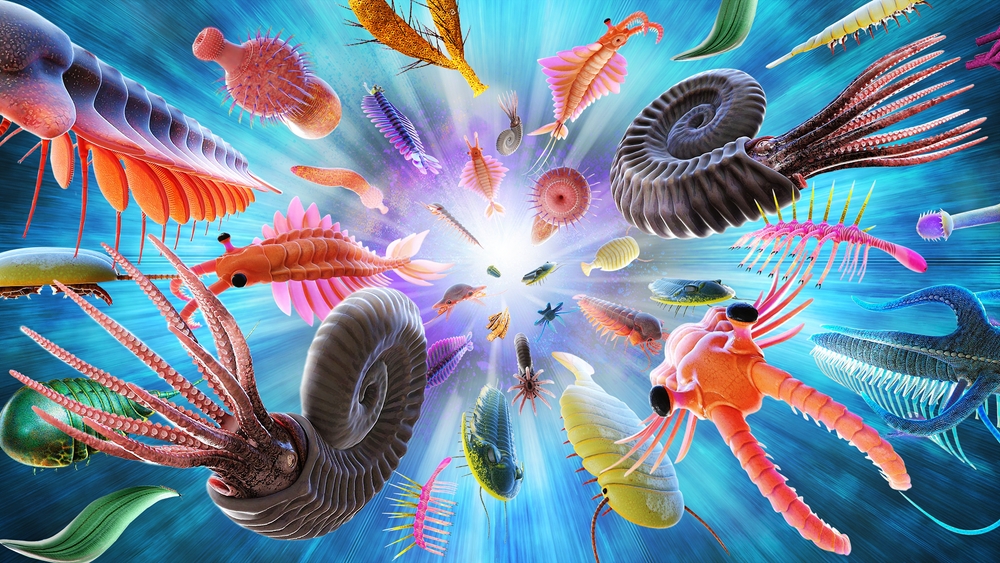
The term “Cambrian Explosion” refers to the appearance and rapid diversification of an abundance of new life forms, some of which were very sophisticated, within an interval of perhaps 20 million years or less. This time is known as the Early Cambrian, and began around 543 million years ago. For millions of years beforehand, there were no complex metazoans and no significant evolution of the simple organisms that did exist. An important unsolved evolutionary mystery is what caused the Cambrian Explosion. A potential hypothesis suggested by the New Paradigm would be that the maintenance system had finally evolved to the point where it could identify and replace specialized components, and/or identify and replace damaged tissues, as opposed to simply replacing dead cells, thus allowing for more complex organisms.
Longevity is a Function of the Capabilities of the Maintenance System
Aging theorists have long noted the fact that the longevity of otherwise similar species can vary remarkably. An obvious example would be rodents. Even under ideal conditions, a lab rat will rarely survive for more than a few years. By contrast, the longevity of the naked mole rat is estimated to be more than three decades. The only explanation for the extreme variances in longevity is that longevity is genetically determined and developed through an evolutionary process in a way similar to the one that determines other species-specific traits.¹
The New Paradigm posits that each species is endowed with a maintenance system that is designed to prevent any diminution in functionality throughout the natural lifespan of the species. If there is no diminution in functionality, then there can be no aging-dependent causes of death. Thus, by definition, the longevity of any species is determined by the capabilities of that species’ maintenance system.
This hypothesis is discussed in greater detail in the essay entitled “Aging in Other Species.”
Evolutionary Choices
Chronological Limitations on the Efficacy of Maintenance Systems
The New Paradigm defines “natural lifespan” of a species to be the period of time before substantially all members of that species would die from non-aging-associated causes (e.g., starvation or predators) in their evolutionary environment. An “effective” maintenance system is one that would be capable of preventing any symptoms of FDS from manifesting during an organism’s natural lifespan.
Evolutionary principles dictate that any mutation that would allow the maintenance system to ensure optimal functionality throughout the natural lifespan of an organism would confer an evolutionary advantage, and thus such a trait would be genetically inherited.²
This hypothesis is discussed in greater detail in the essay entitled “Aging in Other Species.”
Any Disruption of the Maintenance System Will Result in a Degenerative Disorder
Damage-Based Theories of Aging
As a result of the misconception that maintenance of the human organism should be simple, much of the theoretical work in the area of human aging has focused upon identifying types of intrinsic damage that are inevitable and irreparable. One such damage-based aging theory relates to telomere attrition. New cells are typically created through mitosis, whereby a mother cell divides and produces two new cells that are duplicates of the original. However, there is a limit to how many times a cell can divide. Telomeres are special structures at the ends of all chromosomes that prevent chromosomal termini from joining together. Every time a mother cell divides to produce two daughter cells, the telomere length of the daughter cells is shorter than that of the mother. This continues until the critical point at which telomeres can no longer be formed. A typical cell can only divide approximately 50 to 70 times before it reaches the Hayflick Limit, at which point the cell ceases to divide. They become senescent cells, or “SCs.”
Although they can no longer self-replicate, SCs stay metabolically active. Among other thing, SCs emit distress signals alerting the maintenance system that the damaged cells need to be eliminated. The inflammaging hypothesis posits that if SCs are not eliminated, they continue to excrete these signaling molecules. The signaling molecules have an adverse effect on nearby cells, inciting local inflammation (inflammaging). The inflammaging proponents speculate that in younger humans, the immune system eliminates the SCs, but that the aging process causes the immune system to lose the ability to eliminate SCs. The accumulation of SCs causes inflammaging, which in turn causes aging. ³
This analysis has an inherent appeal to life scientists because it focuses on the damage side of the equation. Better yet, it gives the scientists a target. Scientists have identified “senolytic compounds” that are capable of the selective eradication of SCs. Experiments show that administration of senolytics is associated with a decrease in the number of SCs and thus a decrease of the cytokine secretion (distress signals) in human tissues. However, although eliminating SCs appears to have beneficial health effects on mice, no one has been able to demonstrate any beneficial health effects on humans.
The Institute agrees that the glut of molecules, including cytokines, chemokines and proteases, secreted by an SC constitute both a distress signal and information regarding the type of cell involved. But where proponents of the inflammaging hypothesis see those signals as being harmful to the organism, the Institute posits that these chemical signals are further empirical evidence that humans are endowed with a sophisticated maintenance system. So long as the maintenance system is working optimally, it will respond to these distress signals, remove and replace the defective cells, and there will be no accumulation of SCs and no resulting decrease in functionality .
FDS is a Degenerative Disorder
Another critical hypothesis contained within the New Paradigm is that the progressive loss of functionality that results from the physiological deterioration that substantially all humans experience with advancing chronological age (the phenomenon typically labeled “biological aging”) is itself a degenerative disorder. In other words, most of the functional symptoms of biological aging are neither natural nor inevitable – they result from a preventable and curable disorder that the New Paradigm labels “Functional Decline Syndrome” (FDS).
- Goldsmith TC, On the programmed/non-programmed aging controversy, Biochemistry (2012).
- In their evolutionary environment, no mammal ever exhibits any symptoms of FDS. See “Aging in Other Species.” Intrinsic damage is an inexorable force that affects all organisms. Thus, other mammals can avoid the symptoms of FDS only if they do have fully effective maintenance systems. In other words, as an empirical fact, all mammals have fully effective maintenance systems.
- See, generally, Franceschi, C, et al, Inflammaging: a new immune-metabolic viewpoint for age-related diseases, Nature Reviews Endocrinology (2018).
The next essay in this Section is “Degenerative Disorders.”